Bob's Diet: Much More Than You Wanted To Know
Published Last edited
Update 8/11/26: Rethink Priorities tried much harder than me to answer these questions several years before I wrote. They explicitly argue against using neurons as a proxy for moral weight. But their arguments are sufficiently galaxy-brained that I prefer my simpler ones:
-
Their confidence intervals include the possibility that octopi have higher moral weight than humans, because octopi have a higher Critical Flicker-fusion Frequency.[1] But humans have ~1.5 OOMs greater temporal resolution in hearing (via pitch) than sight.[2]
-
They try to measure ~90 different proxies for sentience, and about half of (species, sentience measurement) pairs are unknown. How you deal with this is a nasty statistical problem. It sounds like they made a reasonable adjustment[3], but I worry that by casting such a broad net they added more noise than signal.
-
They only use binary measurements! That’s throwing away so much good data.
I worry that this criticism is ‘sour grapes’ towards a document much better-researched than my own. But my judgement is that their complex model introduces too much error surface area to pay for its advantage in detail and comprehensiveness.
These days I eat everything. My subjective guilt for eating any given animal product is strongly positively correlated to the metrics you’ll learn about below; frequency of consumption is negatively correlated.
Update 1/31/26: This ACX post does most of the data deep dive I have been postponing. They claim fish aren’t conscious. I don’t think consciousness is well-defined, but I have updated down on the moral weight of fish. Today I am pescatarian and trying to kick my egg habit.
Epistemic Status: Every two years God bestows upon me dietary wisdom which I am compelled to share with the world. Unfortunately, God’s new revelations tend to contradict his previous ones, just like in the real Bible. You are reading the gospel of Bob 2025 edition, predicted half life 2 years.
I: Bob’s Diet, A History #
TLDR: #
2017: I read Natural Born Heroes by Christopher McDougall and become convinced that some form of Paleo/Keto/Atkins diet is healthiest. It worked: I lost 40 pounds in ~2 months. I never felt or looked better.
2020: Paul and Lucia, both of whom I met walking the Camino de Santiago, convince me that I am ethically obliged to be vegan. I become vegetarian in October 2020, then fully vegan in August 2021.
2025: I get six separate fevers Jan - June 2025. I always felt that veganism was a health sacrifice, but these fevers are the straw (or the barbell) that breaks this camel’s back. I start eating eggs and dairy in June 2025.
Becoming Vegan #
Ryan and Oliver, two friends from college, convinced the rational part of my brain that factory farming is evil around 2019. I tried for quite a while to reason my way out of this. Here are some horrible arguments against being vegetarian that I knew were bad, but repeated mentally in reflexive attempts to reduce cognitive dissonance:
- Vegetarians annoyingly impose their values on others when they ask to eat somewhere with vegetarian options. (Don’t meat-eaters impose their values too, but get away with it because they’re the majority?)
- Being vegetarian is not on the Pareto frontier of lifestyle changes that help the environment while preserving quality of life. Thus vegetarians are virtue signalers, QED. (But veganism certainly is on the Pareto frontier for maximizing animal welfare, and that’s what I was trying to do!)
- Being vegetarian is blue-tribe, and in 2019 I was in the red tribe (by Stanford standards), though that would change quickly.
- Shouldn’t you just avoid factory farmed meat? This question is complicated and I still don’t know the answer.
During this time period I made a half-hearted attempt to only eat ‘happy meats,’ ie not factory farmed food. This didn’t work for several reasons:
- Labels like ‘cage-free’ are in my estimation fairly meaningless. Even cage free chickens spend their diseased existence in a miserably crowded coop, constantly trodding through a swamp of feces and never seeing the light of day. Maybe there’s a meaningful food label out there that truly guarantees that the animal I’m eating lived a happy life, but I have not found it.
- I wasn’t prepared to quiz friends and restaurants who cooked for me on the origin of the meat I was eating. Not eating meat ever is a thing; you call yourself a vegetarian. Not eating meat that was produced in a factory farm isn’t a thing; people call you obnoxious.[4]
No rational discourse was going to change my meat-eating habits at that point in time. I could not become part of the Soy Boy Blue Tribe. Luckily, in 2021 while walking the Camino de Santiago, I met several vegans I liked. Most influential was Paul.
Paul was vegan for environmental reasons, which I thought was dumb because it is not on the Pareto frontier of lifestyle changes that reduce emissions while preserving quality of life. Paul was not dumb; he had already made all the lifestyle changes on said Pareto frontier. He was vegan, never took planes, always used carpools or public transit, never bought new clothing, never consumed single-use plastic, etc. Paul was monk-like in his dedication, rational in his decisions, and presented normally to strangers; he was a vegan I wanted to imitate. (I cared more about how I presented back then).
A Conflicted Vegan #
I always thought vegetarianism/veganism was a health sacrifice. I continue to believe that the two best dietary heuristics are 1) eat what a caveman would eat and 2) eat what makes you feel good. Veganism was a step backward on both fronts.
My mouth has never stopped watering at the smell of a hamburger on a grill. I was vegan because System II told me it was the right thing to do, not because System I felt guilty.
Initially I hated the aesthetics of veganism. I was living in a frat house. I got called a soy boy much more frequently than I was praised for my ethics. Eventually I stopped hanging out with the people who called me a soy boy, not literally because they called me that, but because they are exactly the type of person you think they are. Gradually veganism meshed well with the rest of my persona.
II: A First Principles Diet #
In June 2025 I decided that veganism was too damaging to my health. Vegetarianism was the default step backward. After realizing I had used this cognitive shortcut, I decided to use first principles to propose a diet; hence this post.
Why is Meat-Eating Bad? #
To some, it is because you are effectively killing animals. When you slaughter a cow or send a bullet through a moose’s skull, it suffers in the moments leading to its death. ChatGPT tells me this is on the order of seconds in both cases, which is small relative to the total suffering experienced by any being.
Killing animals feels not nearly as bad as factory farming, that is, keeping animals alive in horrific conditions. Pigs in factory farms live in pens so small they don’t have the room to turn around. Ammonia-laden air burns lungs and eyes. Baby pigs have their tails cut off, otherwise a pig in another pen will chew it off in distress. I won’t bore you with similar descriptions of other animals.
The Least Bad Metric #
Is there any good way to quantify the suffering of animals? I was hopeful that the rationalist blogging universe would help me find the answer, but it had few concrete suggestions. The best attempt at a first principles approach was something like “neuron count moral weight.” Everyone hates this solution (example), but no one proposes anything better.
I propose something better: . This is of course oversimplified. I sit here awaiting your better metric, dear reader. In the meantime I will use my flawed-but-plausible one.
The Rankings #
I pulled the numbers here from Google / Claude / ChatGPT and did some light sanity checking. I hope they are all within one or two orders of magnitude of the true answer. (Link)[5]
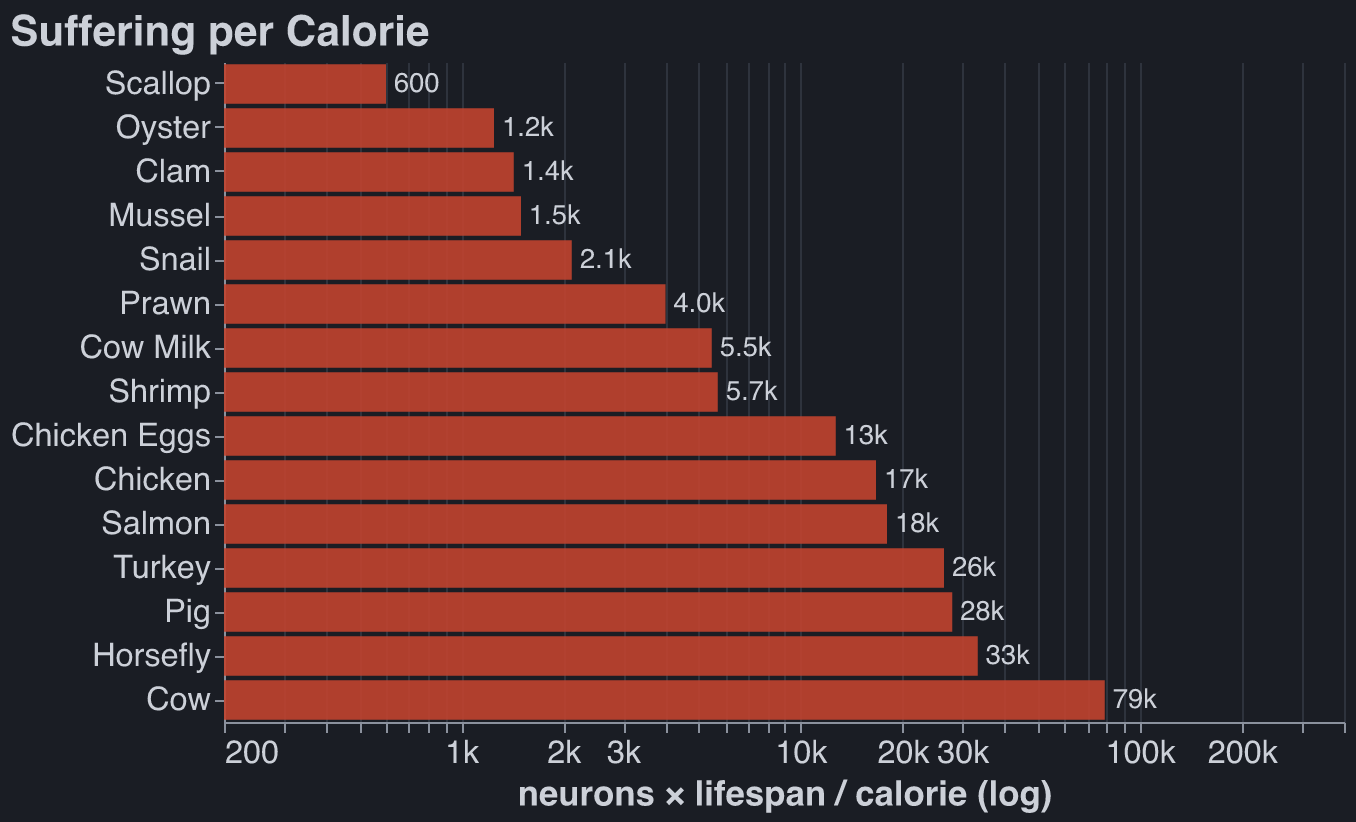
Lifespan reflects the amount of time we can expect the animal to spend on a factory farm, so animals which aren’t farmed don’t appear in this graph.
If you’re going to eat a farmed animal, bivalves (clams, mussels, oysters, scallops) are by far your best bet. Natant decapods (shrimps and prawns) also score well.
Crickets are farmed, and they look inhumane to eat on this metric; it makes me skeptical of my pretty graph too.
III: Objections #
Free Range #
The two obvious strategies arising from this chart are 1) don’t eat factory farmed meat, or 2) don’t eat factory farmed meat unless it’s a bivalve, a crustacean, or dairy.
I have deep apprehensions about eating wild animals and wiping away my guilt:
- I suspect that average consumer eats a roughly fixed amount of, say, beef, and will pay $x more for free-range than factory farmed. I also suspect that the supply of free-range beef is inelastic: beef production is land-intensive. If you agree with these assumptions, then my buying 1lb of free-range beef brings into existence ~1lb of factory-farmed beef. The same goes for wild meat, eg salmon.
- I worry that by buying free-range beef I’d be indirectly burning down the Amazon so that cattle can graze in Brazil. About free-range pork and fowl, I am uneducated.
- It’s not easy to determine whether or not the animal on your plate lived a humane life. I have no trust in certifying labels. I could be convinced that specific farms are good.
I consider this objection unresolved. I’m still curious about:
- How fungible people’s meat consumption is across species.
- If it’s possible for me to buy animal products that I’m extremely confident are humanely raised.
- How land intensive various forms of human animal agriculture are, and how bad this is for the environment.
Don’t You Care About The Environment? #
Yes, I do, and I wrote about this a bit more here.[6]
Farmed Shrimp Eat Fishmeal #
Correct. And fishmeal normally comes from anchovies, which are much smarter than shrimp. ChatGPT wants me to believe that 1 pound of shrimp production requires ~.2 pounds of fishmeal. These anchovies are caught wild. This doesn’t change my conclusions.
Some Animals Don’t Have Brains At All #
Correct. Bivalves don’t have a brain or a central nervous system, and they’re the first animals on my list! People with wrinklier brains than mine propose that total cortical neurons are a better heuristic for moral weight than total neurons. I have no opinion.
IV. Conclusion #
I have decided to include animal protein in my diet, but I want to minimize the animal suffering that this choice causes. Being vegetarian is not the optimal solution to this problem. To determine what is, I will have to answer the open questions in the free range section. For now, I’ll be eating natant decapods, bivalves, dairy, and (guiltily) some eggs.
UPDATE 4/10/2026: I eat everything and feel guilty about it :(.
V. B-roll #
No one farms lobster or crab because they’re cannibals, so you can’t leave them in a shared pen.
Edit: totally a thing, they just keep the animals in cages.
A dairy cow produces 35! liters of milk per day.
A chicken can go from birth to six pounds and slaughtered in 5-7 weeks. They are kept under constant light so that they keep eating, and cages are heated so that no calories are wasted on staying warm.
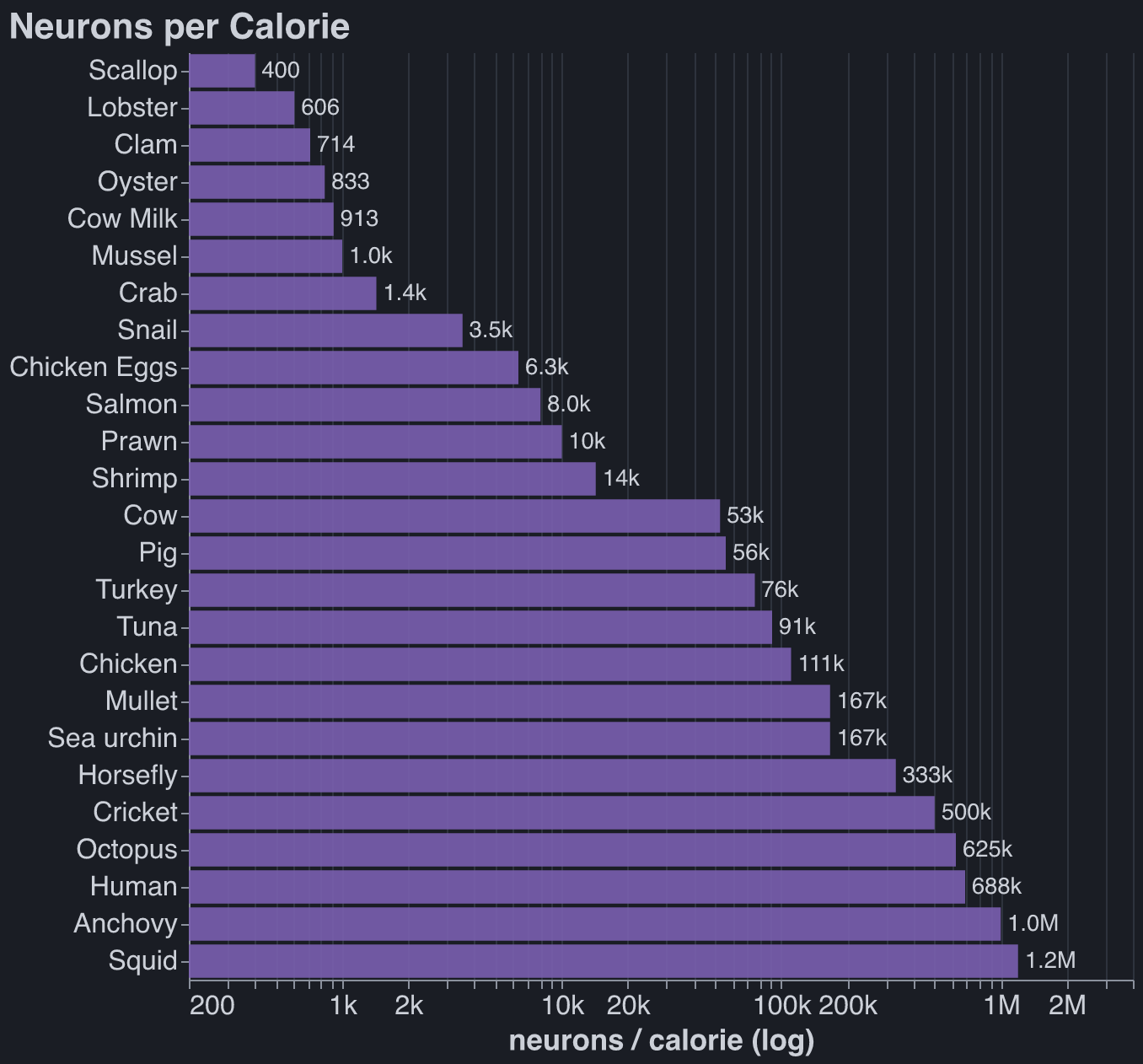
If you think keeping animals alive poses no moral cost and the only evil part is the killing, then I think you’re wrong. But if you’re right, then neurons/calorie is the correct metric. Here’s that table below. Humans fall between anchovies and octopi.
Notes #
CFF: how close together flashes of light are temporally for you to start perceiving them one as one flash. ↩︎
My KISS approach would be to estimate clock speed (frequency at which neurons fire) and assume that the ‘number of sequential neuron firings it takes to produce a perceptually discrete event’ term cancels with the ‘richness/magnitude of said event’ term, because the latter is probably higher if it’s the result of more neurons firing. I have not thought about this hard. ↩︎
Their adjustment: a prior that no evidence for a trait implies that the trait is not present. ↩︎
I know it’s counterproductive, but to this day, people calling themselves flexitarians or claiming the title vegetarian when they do sometimes eat meat annoys me. I appreciate that you eat less meat, but making up a title for this fact comes across as self-aggrandizing. ↩︎
The internet cannot agree on how many calories or neurons there are in a tuna or salmon. I have low confidence in the numbers for vertebrate fish. ↩︎
I don’t know how to perform any calculation that converts kg of emitted to units of suffering experienced by sentient beings. If you can, please let me know! ↩︎
Sources #
Claude found these sources. Robbie did not necessarily review them.
- Rethink Priorities, “Why Neuron Counts Shouldn’t Be Used as Proxies for Moral Weight” (2021). https://rethinkpriorities.org/research-area/why-neuron-counts-shouldnt-be-used-as-proxies-for-moral-weight/ ↩︎
- Verschooten et al., “The upper frequency limit for the use of phase locking to code temporal fine structure in humans: A compilation of viewpoints,” Hearing Research 377 (2019): 109–121 — binaural phase-locking confirmed to ~1,500 Hz, contributors’ upper-limit estimates range 1,500–10,000 Hz, vs. visual CFF’s ~60–90 Hz. https://www.ncbi.nlm.nih.gov/pmc/articles/PMC6524635/ ↩︎
- Holstein Association USA, Do You Know This About Holstein Cattle? — a US Holstein averages ~80 lb (~35 L) of milk a day. https://www.holsteinusa.com/pdf/fact_sheet_cattle.pdf ↩︎
- The Humane League, “What Are Broiler Chickens and How Long Do They Live?” — modern broilers reach ~6.5 lb at ~47 days (about 6-7 weeks). https://thehumaneleague.org/article/broiler-chickens ↩︎